


The Role of Urban Forestry in Reducing the Urban Heat Island Effect
The Role of Urban Forestry in Reducing the Urban Heat Island Effect
Texas cities are heating up—literally. As development accelerates across the state, the number of heat-retaining surfaces like asphalt, concrete, and rooftops is dramatically increasing. An increase in heat-retaining surfaces leads to the “urban heat island effect,” where urban and suburban areas experience significantly higher temperatures than surrounding rural areas. In some cities, the temperature differential can reach 10–15°F or more, posing risks to public health, infrastructure, and energy systems.
Urban forestry is one of the most powerful tools we can implement to combat the urban heat island effect. By increasing and preserving tree canopy, municipalities and developers can create cooler, healthier, and more resilient communities. In this article, Tree Mann Solutions explores how urban trees reduce heat, improve livability, and contribute to sustainable growth across the state of Texas.
Understanding the Urban Heat Island (UHI) Effect
The urban heat island effect occurs when undeveloped land cover is replaced with heat absorbing surfaces. Heat absorbing surfaces retain solar radiation during the day and release it slowly at night, preventing cities from cooling down. Factors contributing to UHI include:
– Impervious surfaces (pavement, rooftops)
– Sparse vegetation
– High building density
– Waste heat produced by vehicles and HVAC systems
The consequences are wide-ranging:
– Increased energy demand for cooling
– Higher utility costs for residents
– Increased air pollution and ozone formation
– Heat-related illness, particularly among vulnerable populations such as young children and the elderly
– Reduced nighttime cooling and increased nighttime temperatures
How Trees Mitigate Urban Heat
Trees reduce UHI through a combination of shading and evapotranspiration:
- Shade Provision: Trees absorb direct solar radiation, reducing surface and ambient air temperatures. Young trees shade approximately 50-100 square feet, established trees shade approximately 300-600 square feet, and mature trees can shade 2500-7500 square feet or more depending on species and age. A single mature tree can reduce temperatures beneath it by up to 20°F.
- Evapotranspiration: Trees cool the surrounding air as they release water vapor from their leaves.
- Wind Reduction: In dense urban settings, trees break up heat-retaining wind patterns and improve air flow.
- Albedo Effect: The albedo effect is the amount of solar radiation reflected by a surface. Lighter-colored leaves reflect more sunlight than dark colored rooftops or pavement, further mitigating absorbed heat.
Quantifying the Impact
Numerous studies have shown the measurable cooling effects of tree canopy:
– A 10% increase in canopy coverage can reduce a neighborhood’s temperature by 3–4°F.
– Tree-lined streets can reduce ambient temperatures by up to 9°F during peak heat hours.
– Cities like Dallas and Austin have identified canopy goals in their Climate Action Plans for this very reason.
Tree Mann Solutions provides urban tree inventory and canopy mapping services that help cities and developers identify where canopy is most needed for UHI mitigation.
Urban Forestry Strategies That Work
1. Tree Preservation During Development
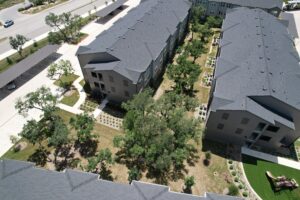
The cheapest and most effective trees are the ones that already exist. Preserving mature trees during construction can prevent canopy loss and help to retain established root systems.
- Equitable Tree Planting
Low-income neighborhoods often have the least amount of canopy coverage —and are affected the most from solar radiation and the urban heat island effect. . Urban forestry plans should prioritize these areas first. - Green Infrastructure Integration
Trees can be integrated into stormwater features like bioswales and rain gardens, offering multiple benefits such as cooling, flood mitigation and wildlife habitat. - Public Space Planting
Parks, schools, sidewalks, and transit stops should be prioritized for an increase in shading infrastructure. During hot months, increased shade coverage can help to make walking and biking more feasible. - Tree Species Selection
Choose native, drought-tolerant species with wide canopies, such as live oak, bur oak, cedar elm, and pecan. These trees thrive in Texas heat, require less resources, and provide long-term shade benefits.
Maintenance and Long-Term Planning
Planting trees is just the beginning. Long-term success requires:
– Irrigation planning, especially during establishment periods and droughts.
– Regular pruning and health inspections: removing failing limbs and identifying poor condition and struggling trees
– Public education: promote tree stewardship and establishing a connection to natural areas
Cities and HOAs must budget for maintenance if they want trees to thrive and deliver cooling benefits over decades. While native trees are often viewed as ideal planting options, the urban forestry industry must advocate for more quality adapted stock and experiment with tree species 1-2 USDA hardiness zones hotter for long-term climate resilience.
Role of Consulting Arborists in Heat Island Mitigation
Tree Mann Solutions supports municipalities, schools, developers, and HOAs by:
– Conducting canopy assessments and GIS mapping
– Developing urban forestry master plans
– Advising on species selection and placement
– Consulting on construction plans to preserve shade trees and reduce habitat loss
– Coordinating with city officials to meet ordinance and sustainability goals
Urban forestry is not just a luxury, it’s a necessity for cities facing rising temperatures. Trees are a proven, scalable, and cost-effective solution to reducing the urban heat island effect. Whether through preservation, planting, or strategic design, trees can help Texas communities stay cooler, healthier, and make them more livable.
If your development, campus, or city needs a partner in strategic canopy planning, Tree Mann Solutions is here to help. Let’s work together to fight the heat—one tree at a time.
Share this Post

